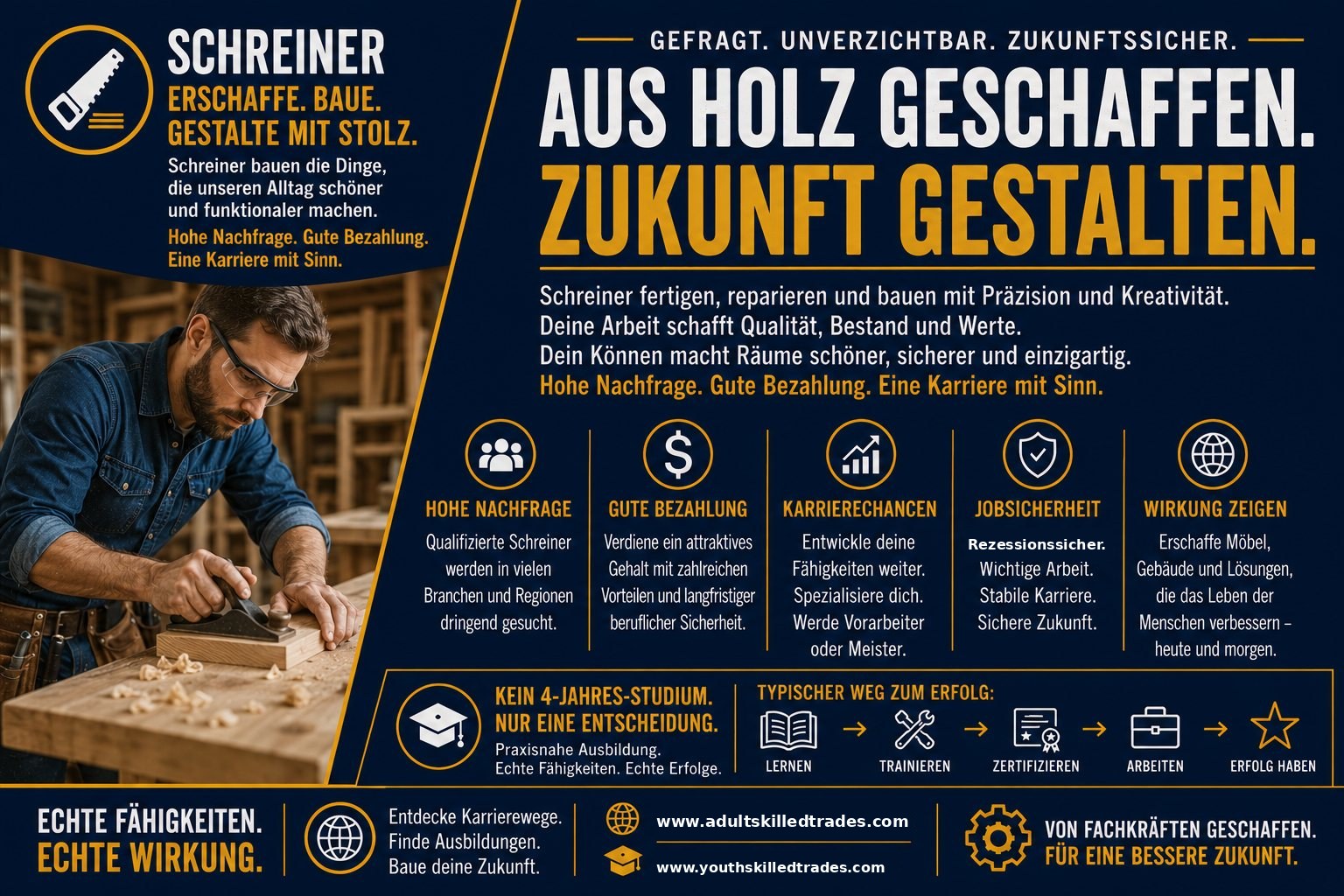
Germany’s dual system is the original earn-while-you-learn. And there is no age limit, thousands start an Ausbildung after 25, 30, or 40. If you already have a career, the Umschulung route was built for you.
Your Ausbildungsvertrag is with a real employer, a workshop, a construction firm, a plant. The contract is registered with your Handwerkskammer or IHK.
Most of your time is paid work in the company; one or two days a week (or block weeks) at the Berufsschule. Duration: usually 2 to 3.5 years depending on the trade.
Apprentice pay (Ausbildungsvergütung) rises each year and is set by trade and region, your Kammer publishes the current rates. A legal minimum apprentice wage applies.
The Gesellenprüfung (journeyman exam), recognised across Germany and, thanks to the EU framework, respected across Europe. From there: Meister.
Umschulung compresses a full trade qualification into roughly two-thirds of the normal time, typically about two years, because you already know how to work. It ends in the same Kammer exam as a regular Ausbildung. The decisive advantage: if the Agentur für Arbeit or Jobcenter approves it, a Bildungsgutschein can cover up to 100% of the cost, and support for living costs may be available during the retraining. This is the standard route for adults leaving shrinking industries for trades that can’t hire fast enough.
Adults with work history, any field, who want a recognised trade credential without starting from zero.
Usually around 2 years, full-time, at a training provider or in a company (betriebliche Umschulung).
Book an appointment with the Berufsberatung at your local Agentur für Arbeit. Say the word “Umschulung.” They map the funding.
| Stage | What it is | What it leads to |
|---|---|---|
| Azubi | Apprentice in the dual system (2 to 3.5 yrs) | Paid training, national exam |
| Geselle/Gesellin | Journeyman, fully qualified tradesperson | Full trade wages, EU-recognised credential |
| Meister/Meisterin | Master craftsman. Germany’s highest trade rank (equivalent in level to a bachelor’s degree in the German qualifications framework, DQR 6) | Train apprentices, lead a workshop, and in licensed trades: open your own business |
The Meister is where the funding gets serious, see Aufstiegs-BAföG and the Meisterprämie.